
If something goes wrong with the sound at a wedding, everyone knows who’s responsible. The DJ. It doesn’t matter if the venue has impossible acoustics, a vengeful neighbour, or rules written before Bluetooth existed. The DJ turned it up. The DJ caused the problem. The DJ should have known better.
I’ve been that DJ. More than once. And I want to tell you two stories — and then give you the fuller picture, because it’s more complicated than most people realise.
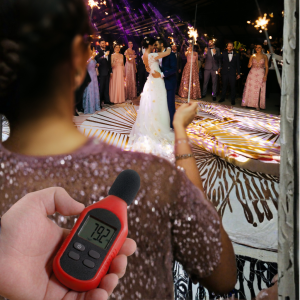
A crowd of cheering wedding guests can hit a venue’s limit with no music playing at all, especially without professional measuring equipment.
Story One: The Owner Upstairs
There’s a venue in Auckland well known among local DJs for its “noise issues.” The owner warned me personally about a difficult neighbour over the back fence — someone who would call the council at the slightest provocation. I took that seriously.
I brought the smallest appropriate system I owned at the time — a Bose L1 Compact, a single column speaker about the size of a standard floor lamp. For context, I’ve used larger systems at house parties. I was being as considerate as I possibly could.
Midway through the evening the owner appeared beside me and asked me to turn the bass down. I’d been very careful with the volume, but I was embarrassed. I apologised. I asked if the neighbour had called – was Is till too loud?
“No,” she said. “I’m going upstairs to bed.”
The venue owner. Going to bed. At 9pm. In her own venue. Which she had hired out to a couple for their wedding reception for several thousands of dollars.
She was the neighbour. She had always been the neighbour.
I don’t do events there anymore.
Story Two: The Stairwell
Corporate hotel event. Ballroom. No residential neighbours anywhere nearby — just the hotel itself above us. Appropriate sized system for the room, nothing excessive.
About an hour in, a hotel manager appeared. Very apologetic. Said they’d had complaints from guests in the rooms upstairs. We turned down slightly and carried on. Another manager appeared. Same story. Then another. By the third visit I was genuinely baffled, and so were the staff. They didn’t usually get complaints, especially from within the hotel. It wasn’t loud, the room was well contained, and this kind of complaint in a hotel ballroom simply doesn’t happen.
Eventually someone found it. A side exit door, hidden behind stage draping, propped open by a few centimetres. A roadie had wedged it earlier during load-in and forgotten about it. That door opened into a stairwell. The stairwell connected to every floor of the hotel above us. We had been funnelling sound directly upward for two hours.
A decibel meter outside the venue would have read nothing unusual. The problem was entirely inside, entirely architectural, and entirely invisible until someone physically found the door.
The moment we closed it, the complaints stopped.
What the Numbers Actually Mean
Most people assume there’s a magic number. A decibel limit. A time after which all music must stop. The reality is more nuanced — and more interesting.
Consider what 80 decibels actually sounds like. It’s a lawnmower. A busy restaurant kitchen. A motorbike passing at close range. Some wedding venues set noise limits at or below this level. Which creates a problem nobody talks about openly:
A crowd of 80-100 guests cheering, clapping, and singing happy birthday can generate 85-95dB entirely on their own — with no music playing at all.
The moment the bride and groom walk into their reception to a standing ovation, or the best man raises a toast and the room erupts, or the first dance ends and 100 people cheer simultaneously — the guests themselves can breach the limit. The PA system isn’t even the issue. The DJ gets the blame anyway.
A decibel meter records a number. It cannot tell you whether that number came from a subwoofer, a crowd of celebrating guests, someone whooping in the carpark, or a party happening at a private home two properties over. It just shows you a reading. Someone then decides what caused it — and that decision is rarely made in the DJ’s favour.
Under Auckland Council rules, noise is governed by the Auckland Unitary Plan and standards vary by zone. Crucially, for residential noise complaints involving parties and music, noise control officers don’t use measuring equipment to decide if noise is excessive. They make a subjective assessment from public or shared areas near the noise source. Wind, rain, air temperature, cloud cover, the number of guests outside — all of it affects what an officer hears when they stand on the footpath.
There is no universal “you can be as loud as you want until 11pm” rule. That myth catches a lot of couples off guard. Noise abatement applies at any hour — a lawnmower at 6am and a DJ at 9pm are assessed under the same framework. For the full Auckland Council noise guidelines: aucklandcouncil.govt.nz/noise
In Defence of Venues — To a Point
Here’s something I don’t hear many DJs say: venues aren’t always the villains in this story.
Think about what a popular wedding venue actually deals with. Every weekend, a different couple, a different DJ, a different crowd. Some of those DJs are exceptional professionals. Some of them turn up with the biggest subwoofers they own, play at nightclub volumes, and leave the venue to deal with the neighbour complaints, the council visits, and the threat to their liquor licence.
When a venue asks DJs to sign a noise agreement, or sets strict volume limits, or threatens to cut power if things get out of hand — sometimes that’s not them being unreasonable. Sometimes that’s them trying to survive a situation created by years of bad experiences with DJs who didn’t care about anyone’s reputation but their own. It gives the venue a leg to stand on, some leverage — because some DJs simply don’t give a toss about the venue, the staff, the owners, or the fact that the venue has to continue as a business long after the party ends.
The couple who hired the cheapest DJ they could find, with the biggest speakers and the least experience, doesn’t lie awake worrying about the venue’s licence and livelihood. The venue does. Every single week.
So I have some empathy and understanding regarding the contract, even when the specific rules in it are clumsy or outdated. I once signed a document requiring speakers to face away from neighbours — while the real issue was subwoofer frequencies that travel in every direction regardless of cabinet orientation. The rule was wrong, but the intention behind it wasn’t unreasonable. Someone had caused a problem before me, and the venue was trying to prevent it happening again.
Where venues do get it wrong is in how they communicate all of this to couples. Which brings me to the part of this that actually matters for you.
What Venues Should Be Telling You — and Many Aren’t
When you view a venue, the noise situation should be part of the conversation from the beginning — not buried in a contract clause the DJ reads on arrival, not mentioned apologetically after the deposit is paid.
If a venue has a noise-sensitive neighbour, a curfew, strict decibel limits, or a history of complaints, you deserve to know that before you sign anything. Because the rules that exist to protect the venue’s licence will affect your night — and right now, in most cases, nobody is telling you that until it’s too late to do anything about it.
Add these questions to your venue viewing checklist:
- Have you had noise complaints in the last 12 months? How many?
- Do you have a noise curfew? What time, and is it negotiable?
- Are there decibel limits? Who enforces them and how?
- Do you have any neighbours with a history of complaints?
- What happens if a complaint comes in during our reception?
- Do you allow subwoofers? (If not, ask why — the answer is revealing)
- Is this venue suitable for a full reception with dancing, or is it better suited to a quieter event?
A venue that answers these questions openly and confidently is a venue that has thought about it and has nothing to hide. A venue that gets vague or defensive has probably had problems they’d rather not discuss until after your deposit clears.

What a Professional DJ Does
A professional DJ doesn’t find out about noise restrictions when they walk through the door on the night of your wedding.
If I’ve never been to a particular venue, I contact them in advance. I ask about neighbours and noise, load-in requirements, power supply, room layout, and anything else that might affect how I operate. I want to know the rules before I arrive, not because someone handed me a clipboard in the carpark, but because surprises on the night of a wedding are never welcome — for anyone.
Your guests don’t know the rules. They’re there to celebrate with you. They’ll cheer, spill outside for fresh air, and yahoo in the carpark at midnight. That’s not the DJ’s fault, nor yours — and a venue that has thought carefully about noise will have planned for exactly that.
Noise is environmental. It’s architectural. It’s human. A decibel meter records a number — it cannot tell you what made it.
I say no to certain venues because saying yes means taking on problems that are completely out of my control. I’m not willing to make that trade — not with someone’s wedding.
I hope this helps!
Nick Logan